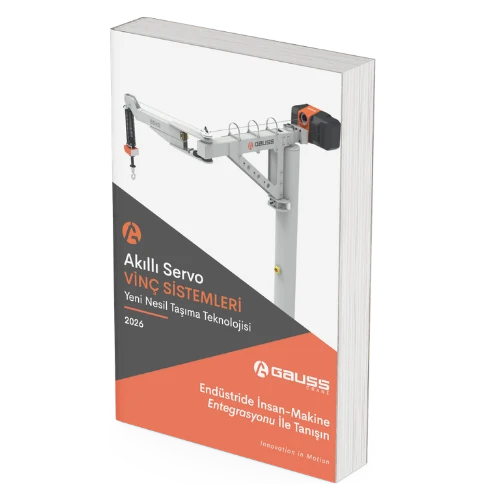
The biggest mistake made when a production line is designed is to see the crane system as “just a lifting device”. In reality the crane is the backbone of your plant’s logistics flow. The two main configurations we offer at Gauss Crane — foldable jib and cartesian rail systems — were developed for different spatial problems.
Foldable Jib Cranes: The Answer to Tight Spaces
Their articulated, foldable construction lets these systems reach the “blind spots” a standard jib crane cannot.
- Mechanical Flexibility: The two-jointed arm lets the operator take a load around columns or other machinery.
- Space Saving: When it is not in use, the arm folds back against the wall and leaves an enormous clear working area on the floor. In aisles with heavy forklift traffic, that is a decisive advantage.
- Installation Figures: Because it mounts on a wall or an existing column, it adds no steel structure cost. On models between 80 and 300 kg, installation takes just 4 hours.
Cartesian Overhead Rails: An Uninterrupted X-Y Line
If a load has to be picked up at one point and set down on another line 10 metres away, the answer is a cartesian rail system.
- Volumetric Reach: Overhead rails cover the whole workstation from above. The operator takes the load to its target by the shortest route on the X and Y axes, with no physical obstacle in the way.
- Modularity: Our rail systems are modular. When your plant grows or your line gets longer, you extend the system simply by adding rail.
Which Should You Choose? (Decision Matrix)
If budget leads: jib systems call for a lower initial investment; cartesian systems give you the maximum operational coverage.
If your ceiling is low: the foldable jib is the better fit.
If your floor traffic is heavy: the cartesian rail system leaves the floor area completely clear.