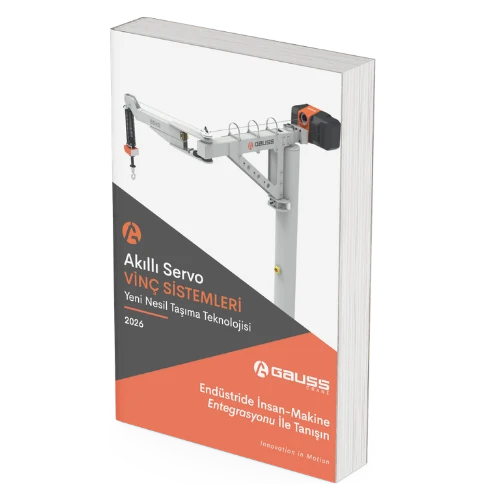
The biggest bottleneck on a production line is not machine speed, it is human fatigue. An operator who lifts a 40 kg part 200 times a day loses concentration badly by the end of the shift, and risks chronic health problems in the long run.
Human-Centred Engineering: Handgrip Technology
Gauss Crane’s patented handgrip technology senses the change of force in the operator’s hand within milliseconds.
- Perceived Weight: Even a 600 kg load reaches the operator as less than 1 kg of resistance. It feels like moving the load in a gravity-free environment.
- Force Sensors: High-resolution sensors in the handgrip read whether the operator intends to go up or down, and channel the motor’s torque in that direction.
Smart Safety Layers That Reduce Accidents
With conventional chain cranes the risks are high: a load released suddenly, an operator’s arm caught. Here the smart system takes on the role of “observer”:
- Overload Protection: The moment capacity is exceeded (300 kg, say), the system blocks all movement.
- Sudden-Movement Damping: If the operator lets go of the handgrip abruptly, the system holds the load in mid-air; it never goes into free fall.
- Speed Limiting: In defined zones — precision assembly points, for example — the maximum speed can be reduced automatically.
What It Delivers to the Business (in Numbers)
- Health and Safety Records: Plants using smart lifting systems have recorded a 45% drop in sick leave taken for musculoskeletal disorders.
- Shift Efficiency: With operator fatigue reduced, the error rate in the last 2 hours of a shift holds at the level of the first hours — stable throughout.
In short: with Gauss Crane you lift more than loads — you lift the strain off your people. A healthy operator is more productive than the fastest machine.